
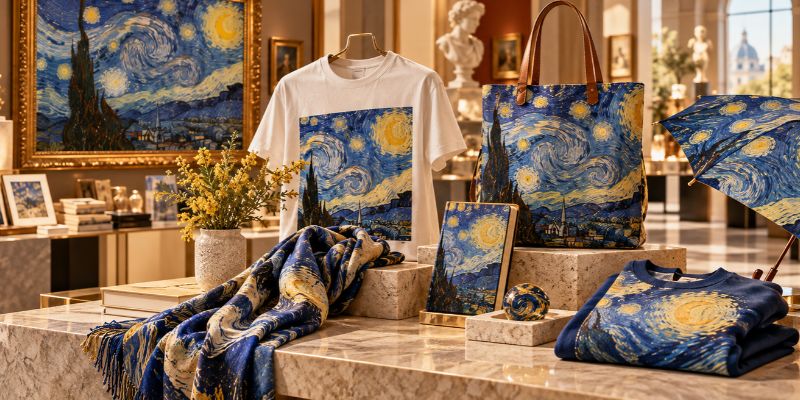
Museum Merchandising: How Cultural Licensing Is Changing Collections and Brands
Museums no longer just sell souvenirs at the exit of their exhibitions. They are building collaborations in textiles, home decor, accessories and stationery to extend their collections beyond their walls.
The latest data from Licensing International confirms the trend: the “Art” category of the global licensed products and services market grew by 5.7% in 2025, after a 7.4% increase in 2024. This is its fourth consecutive year of growth. These figures cover licensed art in the broad sense, not just museum-derived products. [1]
For institutions and cultural merchandising professionals, this raises a key question: what does a licence cover when the artworks concerned have sometimes been in the public domain for centuries?
Cultural institutions step up their presence at Brand Licensing Europe
In an announcement published on 5 October 2026, Licensing International named four new cultural exhibitors at Brand Licensing Europe: the National Gallery, the National Trust for Scotland, the Ashmolean Museum and Tate Enterprises. They join, among others, the British Museum, the V&A and the Van Gogh Museum. [1]
Their presence reflects the growing interest of manufacturers and distributors in heritage collections, particularly in home decor and apparel. These events allow institutions to present their universe to partners who may develop new product ranges. [1]
It is therefore not only about supplying museum shops. Licences can also bring collections into the distribution channels of partner brands.
What do museums actually offer manufacturers?
Each institution runs its own programme, so it would be inaccurate to attribute the same services to every exhibitor.
The National Gallery nevertheless provides a documented example. Its offer includes photography, creative resources drawn from the collections, inspiration packs, design tools, product visualisations and brand guidelines. Its team also supports partners in developing collections. [2]
The value of a partnership can therefore rest on several components:
| Component | Benefit for the partner |
|---|---|
| Iconographic selection | Identify artworks, details and themes suited to a range. |
| Visual resources | Access photography and assets that can be used in the creative process. |
| Creative direction | Build combinations of colours, patterns and products. |
| Documentation | Place the collection within an artistic and historical narrative. |
| Brand guidelines | Present the institution correctly and respect its identity. |
| Support | Work with the institution’s teams during product development. |
These elements broadly match the resources described by the National Gallery. Whether they are included in a partnership must be checked case by case. [2]
A cultural licence is therefore not necessarily just permission to print an image. It can combine rights, resources, expertise and an official collaboration.
Do you need a licence to put the Mona Lisa on a product?
No, not simply because you reproduce the painting.
The Mona Lisa is in the public domain as far as its author’s economic rights are concerned. In France, the general rule provides for protection during the author’s lifetime and for seventy years after the end of the year of their death. Leonardo da Vinci’s work passed that period long ago. [3]
Four elements must nevertheless be distinguished:
- The original artwork.
- The reproduction or file used.
- Any graphic creations added.
- The museum’s trademarks and logos.
The painting’s public domain status does not automatically free every other element used in a commercial project. [4][5]
A faithful reproduction does not automatically create a new copyright
Article 14 of European Directive 2019/790 provides that a reproduction of a work of visual art that has entered the public domain does not attract new copyright or related rights, unless the reproduction is itself an original creation. [5]
A strictly faithful scan of an old painting therefore does not automatically become a new protected work simply because a museum or a photographer made it.
By contrast, an original photograph, a staged composition or a contemporary graphic design may benefit from its own protection. The analysis depends on the originality of the result. [5]
The file you use must be checked
Before starting textile production, you need to examine the file’s provenance and the terms on which it is supplied.
A museum supplying a file does not mean it holds a renewed copyright in the Mona Lisa. The status of the artwork, the status of its reproduction and the conditions governing access to the file must be kept apart. [5]
Moral rights survive in France
Entering the public domain does not extinguish moral rights. The French Intellectual Property Code protects respect for the author’s name, authorship and work. This right is perpetual, inalienable and imprescriptible. [6]
Alterations and distortions must therefore be assessed in context. This does not mean that every adaptation is prohibited, nor that the museum automatically holds a right of approval over every use of an old artwork. [6]
So what do cultural licences cover?
Institutions’ trademarks and logos
Reproducing an old artwork and presenting a collection as an official collaboration are two different things.
The Louvre specifies that its trademarks and logos are protected and that reproducing them requires permission from their owners. The Mona Lisa’s public domain status therefore does not, on its own, allow you to add the museum’s logo or to present a product as officially associated with the institution. [4]
Content that is still protected
A collection may draw on original photographs, texts, illustrations or contemporary graphic creations.
These must be assessed separately: the public domain status of the painting depicted does not automatically extend to every creation made around it. [4][5]
Official association with the museum
Some programmes make it possible to develop products associated with an institution’s brand and expertise.
Royal Museums Greenwich, for example, presents its offer as access to its collections to create products in association with its heritage brand. The value of the partnership then goes beyond access to a reproduction: it includes an identifiable institutional relationship. [7]
Resources and creative support
The National Gallery also highlights graphic tools, photography and partner support. These services can help turn an artistic heritage into a coherent collection. [2]
A company may therefore have good reason to enter a partnership around public domain works without the contract giving it a monopoly over all their reproductions.
Three situations to tell apart before you produce
| Project | Point of caution |
|---|---|
| Reproducing the Mona Lisa from a faithful reproduction, with no museum branding | No Louvre licence is needed simply because you reproduce the painting. The source of the file and any other applicable constraints still need to be checked. [3][5][6] |
| Using a file supplied by the Louvre | Review the terms of supply and re-use that apply to that file. |
| Developing a collection with the museum’s logo or an official presentation | Obtain the relevant permissions and set out the presentation of the partnership precisely. [4] |
The right question is therefore not just “is this artwork old?” but “which elements are we going to use, from which source and under what commercial presentation?”.
For textile merchandising, think in collections rather than single images
For a textile merchandising player such as Sabetrend, these developments call for a distinction between two approaches: designing products inspired by public domain artworks, or taking part in a collection developed officially with an institution.
The latter can bring visual resources, expertise, creative support and a partnership identity. The National Gallery and Royal Museums Greenwich programmes illustrate this approach. [2][7]
Design work then consists of turning an artistic resource into a coherent product: a detail from a painting can become a pattern, a palette can structure a range, and a historical story can enrich how the collection is presented. The creative resources offered by the National Gallery fit this logic. [2]
The rise of cultural licensing therefore does not mean that old artworks are becoming protected again. It reflects the growth of collaborations combining heritage, brands, creativity and museum expertise. [5][2][7]
Legal note: this article sets out general principles within a mainly French and European framework. The status of files, contractual terms and the rules of the countries where products are sold must be reviewed for each project.
Sources
- Licensing International, “Museums Mean Business as Licensing Industry Reports Continued Global Growth”, 5 October 2026. licensinginternational.org
- National Gallery (London), “Brand licensing”. nationalgallery.org.uk
- French Intellectual Property Code, Article L123-1 (term of economic rights; French text). legifrance.gouv.fr
- Musée du Louvre, “Legal information and terms of use”. louvre.fr
- Directive (EU) 2019/790 on copyright in the Digital Single Market, Article 14 (works of visual art in the public domain). eur-lex.europa.eu
- French Intellectual Property Code, Article L121-1 (moral rights; French text). legifrance.gouv.fr
- Royal Museums Greenwich, “Brand licensing”. rmg.co.uk
