
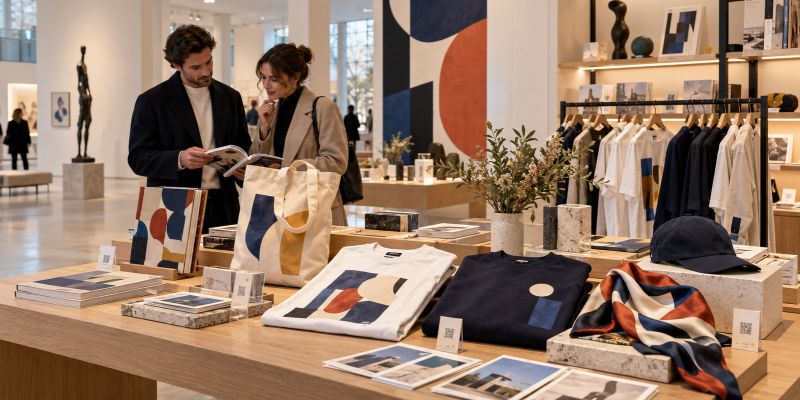
The 10 trends shaping museum shops in 2027
Museum shops are entering a new era. With the rise of cultural collaborations, licensing and lifestyle design, museums are no longer simply selling souvenirs: they are creating desirable, useful and shareable collections that extend the visitor experience far beyond the museum visit. Sabetrend supports this transformation with textile capsule collections designed for museums, foundations, art centres, exhibitions and heritage venues.
From souvenir shop to cultural brand
For a long time, the museum shop was seen as the final stop of the visitor journey: books, postcards, reproductions, a few souvenirs and little more.
That model is changing.
By 2027, museum shops are expected to consolidate a transformation that is already well underway: moving from selling souvenirs to creating cultural products with a genuine identity.
Today’s visitor is not necessarily looking for an item that simply says “I was here”. They are looking for a product they would enjoy regardless of where they bought it: a well-designed T-shirt, a tote bag with a strong graphic composition, a contemporary sweatshirt, jewellery inspired by a collection or a design object for the home.
The shop therefore becomes an extension of the museum experience. It is a space where art, design, fashion, sustainability and storytelling meet, allowing visitors to take away a meaningful part of what they have experienced.
For museums, foundations and heritage institutions, retail also represents a strategic opportunity: to strengthen their brand, reach new audiences, develop additional revenue streams and turn their heritage into contemporary products that visitors genuinely want to wear, use and keep.
1. From souvenir to object of desire
The word souvenir is becoming too limited.
A T-shirt inspired by an artwork, a tote bag with a contemporary graphic composition or a sweatshirt developed from the colours of an exhibition can become a genuine design object.
The shift is significant: cultural products must compete through design, quality, functionality and desirability as well.
The Victoria and Albert Museum shop in London, for example, has developed an offer that goes far beyond the traditional souvenir. Its catalogue includes clothing, accessories, jewellery, books, textiles and editions inspired both by the museum’s collections and by contemporary creative projects. The V&A demonstrates that a cultural institution can offer fashion and design without losing its heritage legitimacy.[1]
In this model, visitors do not buy a T-shirt merely because it carries a logo. They buy it because the garment has personality, good execution and a story worth sharing.
In 2027, it will no longer be enough to print an artwork on a T-shirt. It will need to be reinterpreted.
2. The museum becomes a lifestyle brand
Major museums have assets that many commercial brands spend years trying to build: heritage, authenticity, recognition and a distinctive visual universe.
That heritage can be translated into everyday objects: fashion, accessories, homeware, stationery, children’s products, jewellery, textiles and design objects.
A particularly relevant case is the collaboration between the Musée d’Orsay and Monoprix, developed for the museum’s 40th anniversary. The collection draws on Impressionist and Post-Impressionist works and includes nearly 50 fashion, accessory and homeware products. The initiative brings the museum’s artistic universe into a mainstream retail chain, the museum shop and e-commerce.[2][3]
The collection includes works and references connected to artists such as Monet, Manet, Toulouse-Lautrec, Signac, Berthe Morisot, Eva Gonzalès and Anna Boch. Rather than simply reproducing paintings, it translates colours, compositions and details into clothing, bags, accessories and everyday objects.[2][3]
This type of collaboration illustrates a decisive evolution: the museum is no longer only a physical destination. It becomes a cultural lifestyle brand, present in homes, on the street and in everyday life.
3. Capsule collections linked to exhibitions
Temporary exhibitions offer an exceptional platform for developing small, exclusive collections.
Instead of producing many generic references, museums can create more focused and coherent collections: T-shirts, sweatshirts, tote bags, caps, scarves, accessories, stationery, homeware and limited editions brought together by a common graphic identity.
Design can begin with a major artwork, a nearly invisible detail in a painting, a quotation, a typeface, a colour palette or even the exhibition’s curatorial concept.
The Design Museum in London provides an interesting example with its exhibition devoted to Barbie. The exhibition explored the history of this icon through the lens of design — fashion, architecture, furniture, vehicles and popular culture — while activating a retail selection tied to its visual world. Products, colours, graphic references and merchandising extended the exhibition narrative from the gallery into the shop and e-commerce experience.[4]
The lesson is clear: retail should not arrive at the end of a project, once the entire exhibition identity has already been defined. It should be integrated from the beginning alongside curatorial work, graphic design, communication and exhibition design.
An exhibition can become a collection, and a collection can become a new gateway to the museum.
4. The rise of “museum fashion”
The boundaries between culture, art and fashion will continue to blur.
T-shirts will no longer be merely surfaces on which to print an image. Oversized cuts, heavier fabrics, special washes, embroidery, all-over prints, custom labels and premium finishes will bring museum products closer to the language of contemporary fashion brands.
One of the most compelling international examples is the collaboration between the Van Gogh Museum and Daily Paper. The initiative reinterpreted Vincent van Gogh’s works through a contemporary fashion collection distributed not only in the museum shop, but also through Daily Paper’s physical stores, e-commerce platform and selected international retailers.[5]
The collection used Van Gogh masterpieces as a starting point for clothing, accessories and fashion pieces aimed at an audience interested in design, streetwear or the identity of the brand, even if they had never visited the Amsterdam museum.[5]
Discover the Van Gogh Museum × Daily Paper collaboration
This is not simply about putting art on fashion. It is about using fashion as a new way to interpret, update and disseminate cultural heritage.
5. Collaborations and limited editions
Museum × Designer.
Museum × Artist.
Museum × Fashion Brand.
Museum × Local Creator.
Collaborations will become increasingly important.
A limited edition creates exclusivity, sparks conversation, activates a community and enables a collection to be reinterpreted through a different perspective.
However, the most interesting collaborations will not necessarily be the most high-profile. Emerging designers, illustrators, craftspeople and local creators can offer much more authentic connections to the identity of a museum and its territory.
A particularly relevant example comes from the Getty Museum Store in Los Angeles. Getty collaborated with local brand Utopia to create clothing and accessories made from reused banners

